
Cut and LR-300 slicer
For a direct comparison, obtain specifications for both machines using the same product and operating conditions.
| Highlighted rows show differences | 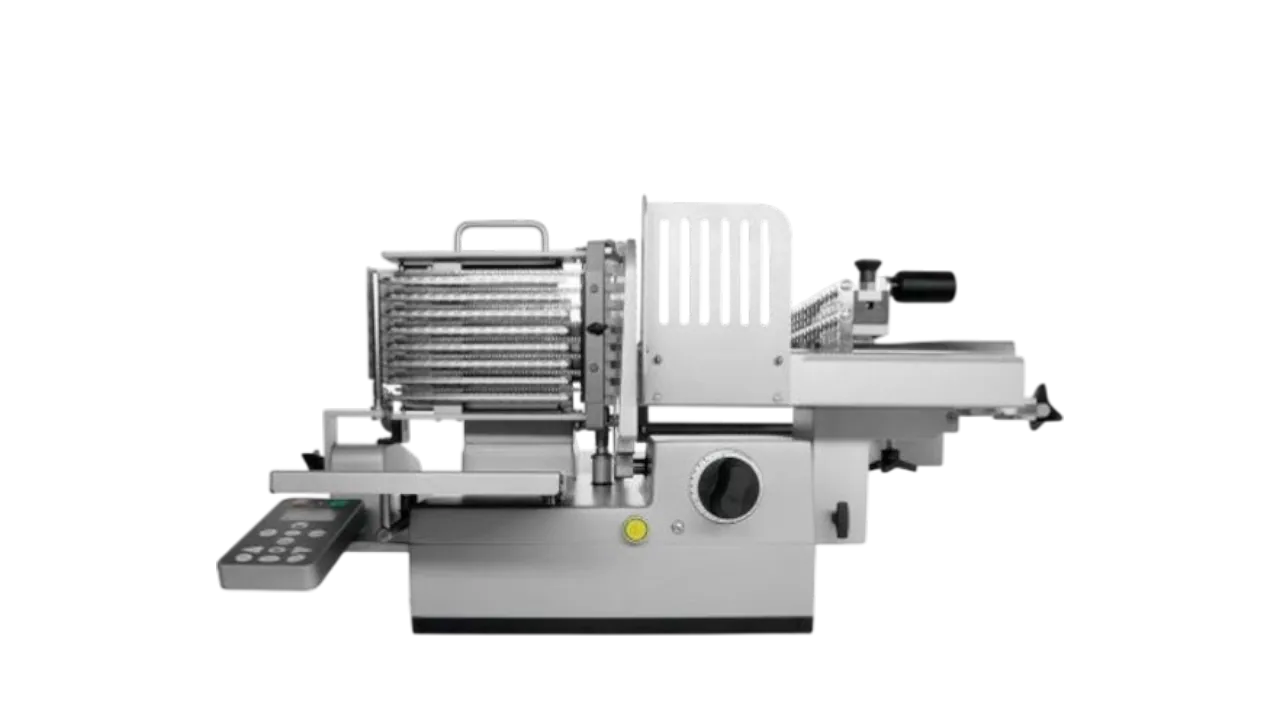 | | 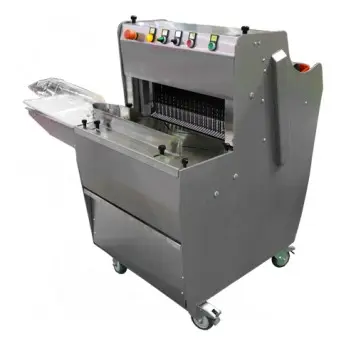 | 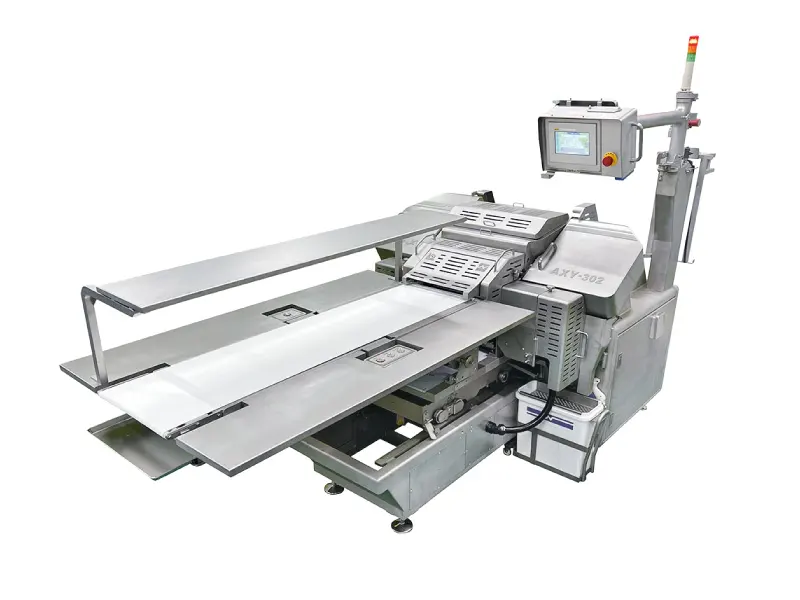 |
|---|---|---|---|---|
| Manufacturer | GRASSELLI NFS | TORGMASH JSC | PROFITEX COMPANY | Nippon Career Industry |
| Model | — | LR-300 | — | AXY-302 |
| Manufacturer country | Russia | Belarus | Russia | Japan |
| Equipment type | Slicer | Slicer | Slicer | Slicer |
| Power, kW | — | 0.16 | 2.2 | 2.13 |
| What sort of meat cutting equipment does Grasselli offer? | Grasselli offers a wide range of modern meat cutting equipment: PAD + KSL DV automatic lines, NSL vertical cut machines, FSL YC semi-automatic sliders with full washing capability, and | — | — | — |
| What's the advantage of PAD + KSL DVD? | The PAD + KSL DV line is ideal when it is necessary to cut the product very precisely by weight. It ensures maximum accuracy of the poreing, which is particularly important for meat manufacturers that are oriented towards standardised meats. | — | — | — |
| How does the KSL DVD machine work? | KSL DVD is an intelligent equipment that automatically defines how to cut product, how many blades are used, and the required slide thickness. This allows for minimizing operator participation and increasing productivity. | — | — | — |
| What equipment is suitable for bone cutting? | The bone-cut is designed to be a vertical NSL cut machine. It produces perfectly uniform slices of both boneless and boneless meat. | — | — | — |
| What is the difference between a semi-automatic FSL YC slider? | The key feature of FSL YC is the possibility of full washing, including inside the equipment. This prevents loss of product, complies with strict sanitary standards and facilitates maintenance at work. | — | — | — |
| What is the purpose of a KSL horizontal cut machine? | The KSL machine is designed to cut fresh boneless meat horizontally. It provides maximum thickness of scraps, which is important for aesthetic and uniform cuts of meat products. | — | — | — |
| Why is it important to use quality cutting equipment? | The quality and attractiveness of meat products depend directly on the correct trim. | — | — | — |
| Diameter of disc knife | — | 300 mm | — | — |
| Thickness of slice | — | 0–18 mm | — | — |
| Product infeed | — | Hand | — | — |
| Parameter description | — | Value | — | — |
| Type | — | semi-automatic, with manual product feed | — | — |
| Disc fresus diameter (mm) | — | 300 | — | — |
| Cut thickness (mm) | — | 0...18 | — | — |
| Set engine power (kW, maximum) | — | 0,16 | — | — |
| Rated power consumption | — | 0.27 kW | — | — |
| Engine speed (rpm) | — | 1400 | — | — |
| Disc cutter speed (rpm) | — | 470 | — | — |
| Dimensions | — | 600 550 450 mm | — | — |
| Power supply: current type rated voltage (V) frequency (Hz) | — | alternate 220 50 | — | — |
| Weight | — | 28.5 kg | — | — |
| Composition of the product | — | Number for modification | — | — |
| Slyser (wheel drive) | — | 1 | — | — |
| Carriage assembly with carriage support and clamping device | — | 1 | — | — |
| Transport pen | — | 1 | — | — |
| Packaging box | — | 1 | — | — |
| Operation manual LR-300 (OM) | — | 1 | — | — |
| Productivity (depending on the bread type), unit/hour | — | — | Up to 450* | — |
| Bread delivery | — | — | mechanical, automatically re-entry | — |
| Cut thickness, mm | — | — | 10, 11, 12, 13, 14** | — |
| Number of knives (depending on cut thickness), unit | — | — | 32 ... 44 | — |
| Maximum height of charge, mm | — | — | 105 | — |
| Minimum height of the charge, mm | — | — | 45 | — |
| Scissor frame amplitude, mm | — | — | 47 | — |
| Power consumption, kW | — | — | 2,2 | — |
| Rated voltage of supply network, V | — | — | 380 (zero-transmission) | — |
| Power of motor-reducor, pushed motor, kW | — | — | 0,25 | — |
| Engine-reducer motor speed, rpm | — | — | 1400 | — |
| Power of electric drive train of knives, kW | — | — | 1,5 | — |
| Dimensions with folded package (D x S x V), mm | — | — | 850 × 1082 × 1148 | — |
| Knife electric motor speed, rpm | — | — | 1400 | — |
| Distance from floor to packing table, mm | — | — | 930 | — |
| Net weight, kg | — | — | 195 | — |
| Package size (box), D x Sh x B, mm | — | — | 1301 × 850 × 1375 | — |
| Gross weight, kg | — | — | 275 | — |
| Type of accommodation | — | — | floor | — |
| Country of production | — | — | Russia | — |
| Beef and pork belly application | — | — | — | Thin belly slices |
| Beef plate, pork jowl and chicken thigh application | — | — | — | Diagonal slices |
| Equipment type | — | — | — | Meat slicer |
| Model | — | — | — | AXY-302 |
| Slicing motion | — | — | — | Vertically reciprocating meat carriage |
| Blade | — | — | — | Straight band knife |
| Feed mechanism | — | — | — | Pressure plate and conveyor belt |
| Maximum product dimensions | — | — | — | With divider: W 140 mm, H 20–75 mm, L 600 mm. Open: W 300 mm, H 20–75 mm, L 600 mm. |
| Slice thickness | — | — | — | 1–20 mm |
| Product temperature | — | — | — | −1 to +5 °C. Optimum: +2 to +3 °C. |
| Slicing speed | — | — | — | 20–100 strokes/min for cuts up to 3 mm; 20–70 strokes/min for thicker cuts, in steps of five |
| Product feeding | — | — | — | Continuous feed |
| Blade sharpening | — | — | — | Intermittent automatic sharpening |
| Blade cleaning | — | — | — | Water-air spray with scraper |
| Motor power | — | — | — | 200 V AC, 2.13 kW |
| Power supply | — | — | — | 200 V, three-phase, 20 A |
| Compressed air | — | — | — | At least 300 L/min at 0.5–1.0 MPa |
| Dimensions (W × L × H) | — | — | — | 1,410 × 2,908 × 2,003 mm |
| Machine weight | — | — | — | 1,060 kg |
| Options | — | — | — | Side table, two-tier table (25 kg), Wi-Fi |
For a direct comparison, obtain specifications for both machines using the same product and operating conditions.
For a direct comparison, obtain specifications for both machines using the same product and operating conditions.
For a direct comparison, obtain specifications for both machines using the same product and operating conditions.
For a direct comparison, obtain specifications for both machines using the same product and operating conditions.
For a direct comparison, obtain specifications for both machines using the same product and operating conditions.
For a direct comparison, obtain specifications for both machines using the same product and operating conditions.