Choosing a commercial bakery oven
Choose a bakery oven for the range of breads and the number of trays, loaves or kilograms that must leave the oven each hour.
At a glance
Choose a bakery oven for the range of breads and the number of trays, loaves or kilograms that must leave the oven each hour. In the furnace section of the Cehmash catalog 317 models from 86 manufacturers - from convection ovens for 10 trays to tunnel ovens for 108 m² of hearth.
The bread oven is the most expensive and longest-lived machine in a bakery. The production, range and consumption of gas or electricity depend on it. Below are the parameters in the order in which it is convenient to check them before applying. Catalog numbers are as of the date of publication.
First the oven type
The type of oven is determined by the range and volume. The same loaf can be baked in different ovens, but the energy consumption, space and ease of operation will be different.
| Type | How it bakes | Who is it suitable for? |
|---|---|---|
| Convection | the fan drives hot air between 400×600 mm baking trays | cafes, mini-bakeries, pastry shops, frozen baking |
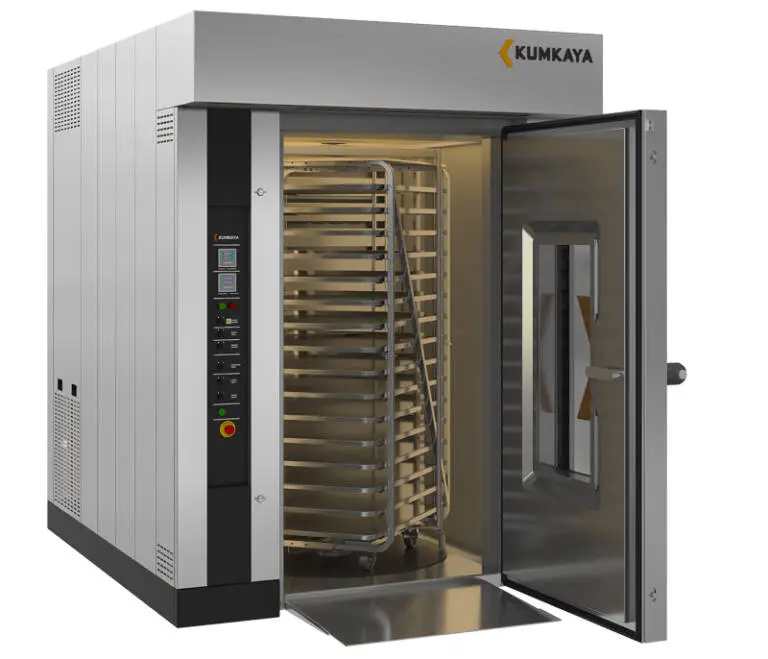
| Rotary | the trolley with baking sheets rotates in the chamber, air blows on it from all sides | bakeries with a wide assortment: tin bread, loaves, rolls, pastries |
| Hearth modular | the product lies on a stone or metal floor, heating from above and below | hearth bread, baguettes, pizza, small quantities |
| Cyclothermic and steam tube | multi-tier oven, heated by flue gases or steam pipes | bakeries and large bakeries with hearth bread |
| Tunnel | the product runs along a belt through a long chamber | bakeries, cookies, drying, lines |
Read more about the differences in the article “How to open a bakery: list of equipment”.
Productivity: count from the product, not from the area
The area of the hearth in square meters in itself says little: a loaf of 0.4 kg and bread of 0.8 kg take up different space and are baked for different times. Therefore, ask the supplier for the output in kg/h on your products.
This is how it looks in the catalog listings:
| Model | Type | Area or loading | Release according to manufacturer |
|---|---|---|---|
| PR-100 | rotary | pallets 790×590 mm | 125 kg/h loaf 0.4 kg, 100 kg/h bread 0.8 kg |
| PR-150 | rotary | pallets 1040×750 mm | 244 kg/h loaf, 250 kg/h bread |
| LIDER 180 | cyclothermic hearth | 18 m², 4 tiers | 672 loaves of 300 g per hour |
| G4-KhPF-16M | dead-end cradle | 16 m² of storage, 27 cradles | 504 kg/h tin bread 0.7 kg |
How to estimate the desired release:
- Calculate the daily output in kilograms for each product.
- Divide by oven operating hours - excluding preheating and loading time.
- Add 20-30% for peak days and new positions.
- Check with the release that the supplier confirms for your product.
Fuel and connection
Fuel determines not only the bills, but also the connection project. The catalog contains stoves using electricity, natural and liquefied gas, diesel, and some hearth stoves using pellets and wood.
The difference is visible on one model. Rotary LIDER 140 in the gas version it consumes 4.1 kW of electricity and about 7.3 m³/h of natural gas, and in the electric version - 63.5 kW. At the large LIDER 300 the electric version already requires 118 kW.
Before applying, check:
- allocated electrical power and voltage 380 V;
- the ability to supply gas and coordinate gas equipment;
- hood and chimney: gas stoves have an exhaust gas pipe;
- room height - for rotary PR-140G the manufacturer indicates no less than 4 m.
Steam, temperature and control
Hearth breads and loaves require steam at the beginning of baking. The built-in steam generator requires a water supply: KUMKAYA rotary ovens have a working water pressure of 3–5 bar. If the water is hard, ask about water treatment - scale damages the steam generator.
The maximum temperature for bread ovens in the catalog is usually 300 °C. More important is how the oven maintains the set mode: how many programs the controller stores, whether it is possible to set step baking, whether there is a steam timer and turning off the rotation of the cart.
Trays, trolleys and the rest of the line
The size of the pan ties the oven to the proofer, racks and carts. If the bakery already has carts, the oven is matched to them, and not vice versa.
- 600×400 mm - convection ovens, for example LIDER 45 for 16 baking trays;
- 600×800 mm - small and medium-sized rotary, for example LIDER 90 for 10–12 baking sheets;
- 740×980 and 1000×600 mm - large rotary, for example LIDER 250 and LIDER 300.
Ask if the cart is included and if it will fit your proofer.
Area, weight and installation
The furnace is a heavy machine: the rotary LIDER 90 weighs 1400 kg, the LIDER 300 - 3650 kg, the steam tube BR 180 - 12,600 kg. Some stoves are delivered disassembled and assembled on site. Specify the width of the openings, the load on the floor, the assembly time and who is performing the commissioning.
Where are bakery ovens made?
In the furnace section of the catalog 317 furnaces from 86 manufacturers. The section is mixed: in addition to bread ovens, it has tunnel ovens for cookies, drying ovens and equipment, so the number of baking models is smaller.
The sample includes factories from Japan, Russia and Turkey. Most models have KUMKAYA — 39 ovens from mini-convection to tunnel, Turkish Unibake - 23 and y Shebekinsky Machine-Building Plant — 10.
All models are in stove catalog.
Checklist before application
- What output in kg/h does the oven produce on my products?
- How long does it take to bake and warm up from cold?
- What fuel and what is the consumption per hour - gas, electricity, diesel?
- What electrical power is needed for the fan and drive?
- Is there a steam generator, what water pressure is needed?
- What size pans and is a cart included?
- What are the dimensions, weight and minimum height of the room?
- Is the furnace delivered assembled or assembled on site, who does the commissioning?
- Where are the spare parts: heating elements, burner, door seals, platform drive?
- Is there a declaration of conformity with TR CU 010/2011 and, for gas furnaces, TR CU 016/2011 “On the safety of apparatus operating on gaseous fuels”?
Common mistakes
- Select by hearth area without calculating output. The area is the same, but the output for different products differs significantly.
- Forget about connecting. An electric rotary oven requires 50–120 kW - not every room has such power.
- Buy the oven separately from the proofer. If the cart does not fit into the proofing chamber, the dough will have to be transferred.
- Take a tunnel oven for growth. The tunnel oven is only effective with continuous loading; at a small volume it sits idle and warms the air.
You can compare models in the section comparisons, and if you need help with a set of equipment, describe the bakery in selection. The entire set of machines is collected step by step in the article “Equipment for bread production”.
Frequently asked questions
01What kind of oven does a small bakery need?
Most often - a rotary one for one trolley or a modular hearth for 1-3 tiers. For example, the rotary LIDER 90 takes 10–12 baking trays 600x800 mm, the modular hearth EF 12080 takes from one to three tiers with a chamber of 1200x800 mm. The choice depends on the assortment: it is more convenient to bake tin bread and rolls in a rotary oven, while hearth bread is more convenient to bake on a hearth.
02What is more profitable: gas or electric oven?
Depends on tariffs and connection. The electric version of the rotary kiln consumes tens of kilowatts - for LIDER 140 it is 63.5 kW, and the gas version is enough for 4.1 kW for the fan and drive with a natural gas consumption of about 7.3 m³/h. Compare the cost of an hour of work at your tariffs and the cost of gasification.
03How to understand the performance of the furnace if it is not on the listing?
Ask your supplier for the output in kg/h on a specific product and the baking time. If only the hearth area is known, estimate the number of products per load and multiply by the number of loads per hour. For Shebekin rotary ovens, the productivity is indicated for a loaf of 0.4 kg and bread of 0.8 kg - this is how it is convenient to compare.
04Do you need a steam humidifier?
For hearth bread, loaves and baguettes - yes: steam in the first minutes of baking gives a shiny crust and prevents it from hardening early. Most rotary and deck ovens have a built-in steam generator, so you need a water supply with a pressure of 3-5 bar. Check to see if water treatment is needed.
Sources
Live catalogue counts update automatically. Other model and manufacturer information reflects the catalogue at publication. Ask suppliers for prices and lead times. Found an error? Contact us.
Bakery and confectionery ovens in the catalogue
All models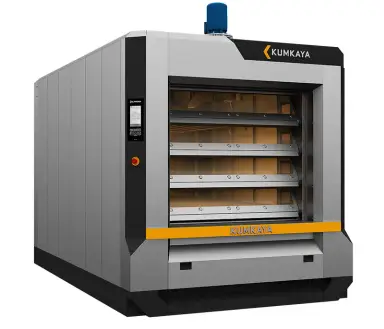
KUMKAYARussia
Kumkaya LIDER 100 cyclothermic deck oven
Bakes the product at a set temperature. Power — 4.5 kW.
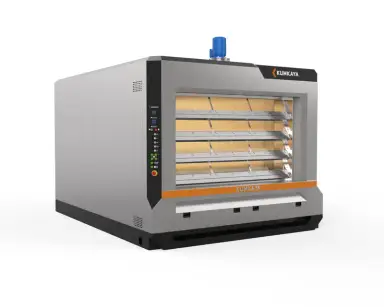
KUMKAYARussia
Kumkaya LIDER 150 cyclothermic deck oven
Bakes the product at a set temperature. Power — 4.5 kW.
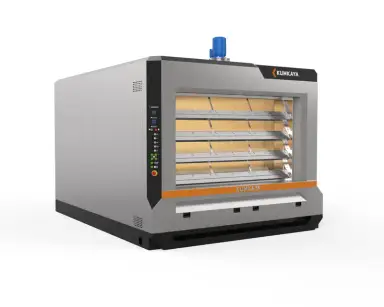
KUMKAYARussia
Kumkaya LIDER 180 cyclothermic deck oven
Bakes the product at a set temperature. Power — 4.5 kW.
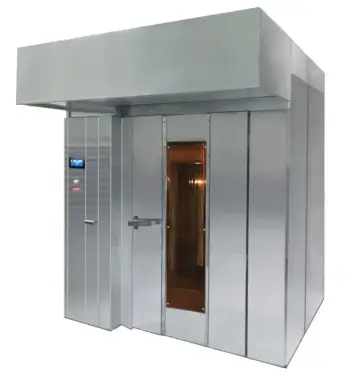
SHEBEKINSKY MACHINE-BUILDING PLANTRussia
PR-140G en furnace
Bakes the product at a set temperature.