How to choose a tray sealer
Compare tray sealers by throughput, tray size and depth, dies, vacuum, gas flushing, skin packaging, film and washdown requirements.
At a glance
Start with packs per hour, the tray formats you use and the sealing method you need. Choose between simple sealing, modified-atmosphere packaging, vacuum and skin packaging. These requirements determine whether you need a manual, semi-automatic or inline machine, which dies to order and what options to include. In November 2026, Cehmash listed 50 machines in the category from 22 manufacturers, including 23 Russian models.
This guide covers both a first tray-sealing line and replacement equipment. See the tray sealer pricing guide for cost factors or thermoformer versus tray sealer to compare packaging methods. Catalogue figures refer to November 2026.
Step 1. Calculate the packs you need per hour
Divide packs per shift by the hours the packing station actually runs. When a supplier quotes cycles, multiply by trays per cycle to calculate packs in the same time period.
| Rated output or cycle rate | Machine type | Catalogue example |
|---|---|---|
| Up to 500 packs/h | Manual benchtop | Volvac TS350, up to 500 packs/h with trays 33–65 mm deep |
| 60–120 cycles/h | Semi-automatic with vacuum and gas flushing | Volvac W450VG, 2.2 kW, 470 mm film |
| 4–5 cycles/min with gas flushing | Rotary tray sealer | Volvac AXIS, 105 m³/h vacuum pump and 99 programmes |
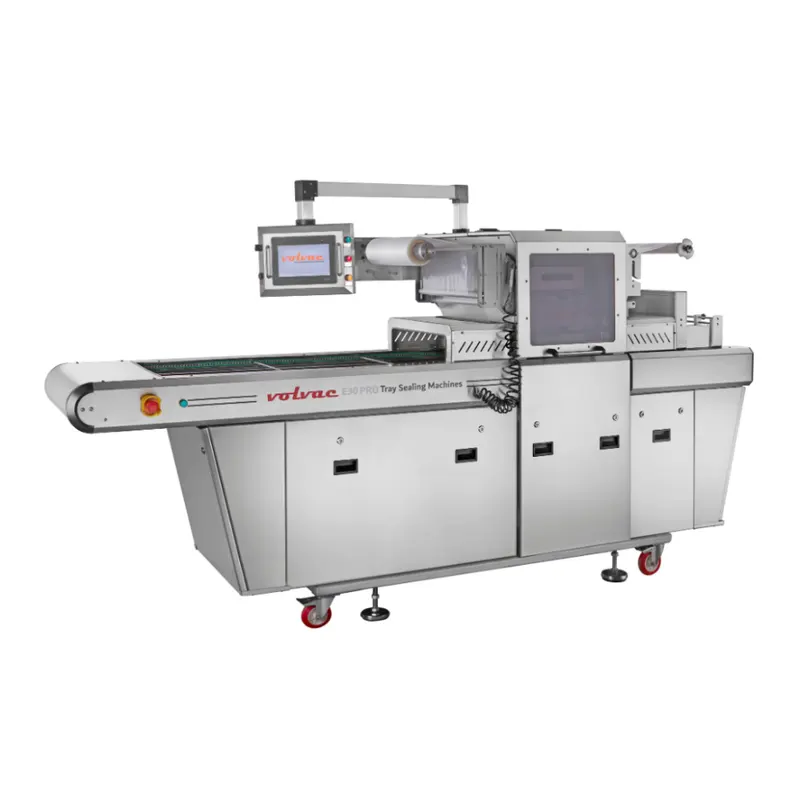
| 360–1,200 packs/h | Automatic | Volvac E30 PRO, 5.5 kW |
| Continuous line | Inline automatic | ULMA TSA 680 P, up to 25 cycles/min. TSA 1200 P, up to 23 cycles/min, 330 × 1,200 mm sealing area |
Evacuating and flushing trays adds time to the sealing cycle. Ask for the rate in the mode you plan to run.
Step 2. Check trays and dies
- Number of formats: Allow one die per tray format.
- Tray dimensions and sealing area: The sealing area determines how many trays fit per cycle. ULMA TSA listings include 330 × 540, 330 × 680, 330 × 875 and 330 × 1,200 mm areas.
- Tray depth: ULMA TSA variants accept trays up to 80 or 120 mm deep. The Volvac TS350 lists up to 65 mm.
- Tray material: Plastic, film-lined paperboard and aluminium need different sealing conditions. Confirm the materials your machine can seal.
- Die change: Ask for changeover time if you switch products several times per shift.
Step 3. Choose the packaging atmosphere
| Mode | Typical use | Equipment needed |
|---|---|---|
| Sealing without gas | Prepared meals, salads and other short-shelf-life products | Heat sealer and lidding film |
| Modified-atmosphere packaging (MAP) | Chilled meat, poultry, sliced products and cheese | Vacuum pump and gas mixer |
| Vacuum packaging | Products that tolerate pressure from the film | Vacuum pump |
| Vacuum skin packaging | Steaks, fish and products where presentation matters | Skin option and compatible film |
If you need gas flushing, ask for gas consumption per pack and the accuracy of gas mixing.
Step 4. Confirm film and roll specifications
- Catalogue examples use film widths of 450–470 mm. The VARIOVAC Linus 1100 lists 410 mm for outside cutting and 350 mm for inside cutting.
- VARIOVAC and TIAMAT examples list rolls up to 300 mm in diameter with a 76 mm core.
- Check who supplies compatible film in your market and whether it seals to your tray material.
Step 5. Check line integration, washdown and utilities
- Tray feed: Decide between manual loading, a conveyor and integration with a filler or slicer.
- Cleaning: The ULMA TSA 540 and TSA 875 are listed as IP65 and the Volvac E30 PRO as IP63. Confirm how the machine can be washed down.
- Utilities: Check the electrical supply, compressed air and gas source. The Volvac AXIS and E30 PRO specify 35 L of compressed air per cycle.
- Controls: Check recipe storage, the touchscreen and the fault log.
Questions to ask the supplier
- How many packs per hour can the machine produce with my tray and product, with and without gas flushing?
- Which tray materials and sizes can it seal? What is the maximum depth?
- How much does a die for a new format cost, and what is its lead time?
- How many trays fit in the sealing area per cycle?
- Are gas mixing, vacuum and skin packaging standard or optional?
- Which film do I need, and where can I buy it?
- How long does a die change take?
- Who commissions the machine, where are spare parts stocked and what does the warranty cover?
When to choose another packaging machine
- High, stable volume in one format: A thermoformer can reduce packaging costs by forming trays from rollstock.
- Products that do not need a tray: Consider a vacuum packaging machine for whole sausage logs, cheese wheels or cuts of meat.
- Dry products such as biscuits and bars: Consider a flow wrapper.
Where costs can rise unnecessarily
- Buying an inline machine when a semi-automatic unit can meet the target.
- Paying for skin packaging when the product will run in MAP.
- Ordering dies for formats that are still unconfirmed.
- Buying more sealing area than the tray layout needs.
What the catalogue lists
At publication, the category contained 50 machines from 22 manufacturers. The largest groups were from Russia (23 models), Taiwan (10), Türkiye (5) and Germany (4). The catalogue currently lists 38 models for Russia. At publication it listed 7 for Uzbekistan. Zay Lon had 10 listings and ULMA had 5. Most of the Zay Lon listings in this category are chamber vacuum machines, so check the application before comparing them. Tray sealers are listed for ULMA, Volvac, VARIOVAC, G. Mondini, TIAMAT, Great Engineering and MAGIKON.
Browse the tray sealer catalogue or use the equipment finder to describe your line.
Frequently asked questions
01How many tray dies do I need?
Allow one die per tray size and shape. Products that share a tray can share a die. Standardising on fewer tray formats saves on tooling and changeovers.
02Can the same tray sealer run MAP and skin packaging?
Some models support both. Skin packaging needs a dedicated option and suitable film. Confirm which modes are available and how long it takes to change between them.
03Which tray sealer suits a new line?
For hundreds of packs a day, consider a semi-automatic vacuum and gas-flush machine such as the Volvac W450VG class, rated at 60–120 cycles per hour. A manual benchtop sealer can suit small runs of trays without gas flushing.
04How does a tray sealer differ from a vacuum packaging machine?
A rigid tray protects the shape of the product and can hold a modified atmosphere. A vacuum bag can cost less per pack when the product tolerates compression.
Live catalogue counts update automatically. Other model and manufacturer information reflects the catalogue at publication. Ask suppliers for prices and lead times. Found an error? Contact us.
Tray sealers in the catalogue
All models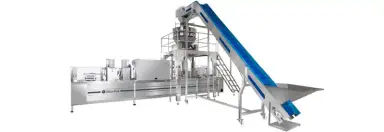
BETAPAK MAKINE A.Ş.Türkiye
Linear machine for filling and refilling Betapak BPH-S-2 LINEER
The machine fills the cups and fills them with a cloaked tape.
15 kW
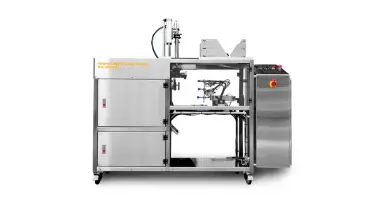
Kong Shiang EngineeringSingapore
Automatic baggage (fill and seal) (weight) (KSE-ABFS2000-W)
Seals trays with film.
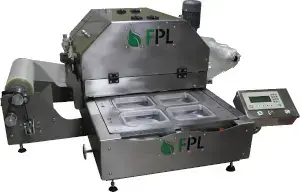
OLMAG PCRussia
AlMag Tray Scrap Scout FPL3/0
Seals trays with film. Power — 2.2 kW.
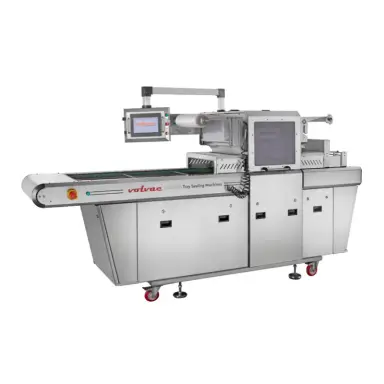
VolvacTürkiye
Automatic trailer Volvac E30 PRO
Seals trays with film. Power — 5.5 kW.